
In The Sacred Canopy: Elements of a Sociological Theory of Religion, published in 1967, Peter Berger describes religion as a type of knowledge that we make out of our own lives. He explains three stages: briefly, we pour ourselves out into our social and physical surroundings, then we believe that such outpourings are facts, then we absorb this created world into our lives. In other words, we construct a culture and then are constructed by it, viewing it as a religion when its source seems to lie beyond ourselves.
Berger’s first step is externalization, “the ongoing outpouring of human being into the world, both in the physical and mental activity of man.” Unlike more instinctual mammals, “Man must make a world for himself.” The result of this work is his culture, made up of his tools, language, ideas, and institutions.
The second step is objectification. The culture that people create becomes a fact outside of themselves. We can no longer manipulate it at will. “Once produced, this world cannot simply be wished away.” As a result, it acquires a coercive character. We created laws, political institutions, and technology. Now, they have power over us.
The third step is internalization. Through socialization in families, schools, work, and communities, “the social world…is not passively absorbed by the individual, but actively appropriated by him.” (Italics in the original.) The individual is a constant participant in this internalization. He “keeps ‘talking back’ to the world that formed him and thereby continues to maintain the latter as reality.”
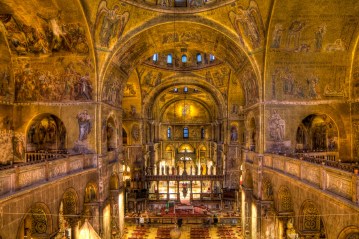
(arounddeglobe.com)
Taken as a whole, this three-step process turns out to be “an ordering of experience. A meaningful order…is imposed upon the discrete experiences and meanings of individuals.” Its role is primarily “as a shield against terror.” It takes on a “sheltering quality.” When this ordering “is taken for granted as appertaining to the ‘nature of things,’… it is endowed with a stability deriving from more powerful sources than the historical effort of human beings.” It becomes, in other words, religion.
“The cosmos posited by religion both transcends and includes man. The sacred cosmos is confronted by man as an immensely powerful reality other than himself.…Religion implies the farthest reach of man’s self-externalization, of his infusion of reality with his own meanings….Put differently, religion is the audacious attempt to conceive of the entire universe as being humanly significant.”
To me, Berger’s analysis makes sense as an explanation of how religion can be both a fallible human product and an authoritative, powerful creation at the same time. His description certainly applies to my view of our biological history as a meaningful and sacred canopy.
 Lives on Earth