
Is DNA alive? No, it’s not alive…mostly. The only sense in which a DNA molecule is a living thing is that it makes copies of itself, although it can’t even do that on its own. Otherwise, DNA fails all the tests: it doesn’t process any kind of fuel in order to maintain its state, it doesn’t grow and develop, so it has no energized activity that starts or ends—in other words, it’s not born and it doesn’t die.
Somewhere along the line in reading general science I picked up the impression, even though I knew differently, that DNA strands are alive. They are such vital keys to living organisms, and I’d read so many descriptions of what DNA does and of “selfish” genes, that although I knew they were blueprints of a sort, they came to seem like living blueprints.
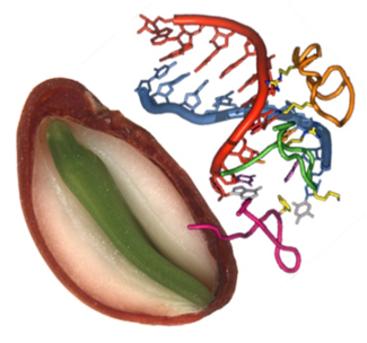
(kew.org)
One image in the back of my mind was that DNA was a kind of seed, and seeds, I thought, are alive. But no, seeds are not fully alive either. They are not active and, until they germinate, they don’t change or develop. (Another familiar item that may seem alive but that doesn’t meet all the criteria are viruses. Viruses are bundles of DNA that become active only when they are inside a cell, at which point they take over the cell and give us the flu.)
It shouldn’t be surprising that some familiar biological components do not by themselves meet all the criteria for the state we call “being alive.” But I was surprised anyway about DNA. Perhaps because we humans are so fully aware that we are alive, it is easy to think that there must be a fully living seed or even a soul at the core. It is almost more than we can imagine that the liveliness we feel is the product of a complexity of non-living parts. It’s an astounding thing.
 Lives on Earth