
Back in 1977, the cosmologist Carl Sagan wrote a book called The Dragons of Eden. Sagan described the long evolution that preceded humans and argued for the likelihood of other intelligence evolving elsewhere in the cosmos during all that time. After all, he wrote, “The world is very old, and human beings are very young.”
To highlight his point about the youth of our species, Sagan imagined the history of the cosmos as a twelve-month calendar. Each month would represent about 1.1 billion years; one day would last 38 million years. Here are some items on the calendar (with dates from the Wikipedia version):
On January 1, the Big Bang explodes.
On March 11, the Milky Way forms.
On September 2, our Sun shines and the planets appear soon after.
On September 21, the first living cells stir.
October brings photosynthesis, the gradual oxygenation of the atmosphere, and the persistence of simple bacteria and their cousins.
In November, the single cells develop nuclei, complexity, and greater energy, leading to the first multi-celled organisms in early December
In December, the variety of life emerges swiftly: fish and land plants in mid-month, dinosaurs at Christmas Eve, then birds and flowers, and just before midnight on New Year’s Eve, modern humans.
Here is a visual rendering of cosmic December:
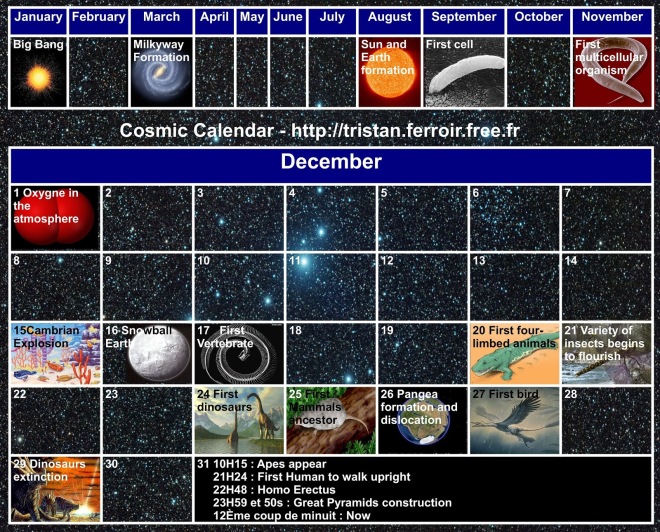
What strikes me about the calendar is not only the late arrival of humans but also, and even more strongly, the early arrival of life itself. September 21 marks the cosmic date for the beginning of microscopic life. From that date on—for more than a quarter of the entire duration of the universe—living organisms have existed on Earth. Humans may be newcomers, but living things are not. The cells in our body have their “months” of cosmic history.
On our domestic calendars we mark the birthdays of ourselves and our family, of America’s independence and its great leaders, and of Jesus. Should we add September 21 as the Birthday of Life?
 Lives on Earth