Are there any viruses that are good for us? Any that will rejuvenate a liver, improve the digestion, smooth the skin – in addition to the villains that bring on polio, smallpox, Lyme, HIV, and the flu? After all, certain bacteria digest our food even though others cause botulism and strep throat. Viruses come in plenty of varieties. Aren’t any of them at least no cause for alarm in our bodies?
On the face of it, no. The basic action of viruses is destructive. These strips of DNA or RNA, enclosed in protein, don’t maintain a metabolism, can’t produce new protein, and can’t reproduce on their own. They are not alive – not in the usual sense of the term. Viruses do only one thing that living cells do: they evolve. (Which is why we need a new flu virus vaccine each year.) But although a virus can’t reproduce by itself, it knows enough to insert itself into a living cell’s DNA, forcing the DNA to make a new virus. The vocabulary for this process is military and agressive: the virus ‘takes over,’ ‘high-jacks,’ ‘subjugates’ or ‘commandeers’ the cell. The cell continues to make viruses, or it withers, or it bursts. The cell dwindles. The half-alive virus flourishes.
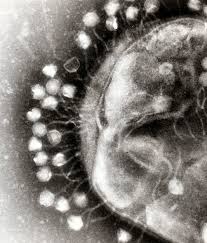
In contrast to viruses, bacteria are living, single-cell organisms. They seek food and process it. They divide into two bacteria on their own. Because they are alive, bacteria can be killed – by antibiotics, by the body’s immune system, or even by particular viruses, bacteriophages, “bacteria-eaters”.
But viruses can not be killed in the same sense. They have no metabolism to disrupt. Instead, anti-viral medications disrupt and slow down their ability to usurp a healthy cell’s genome. But that takes time. If a weakened virus or a piece of one is injected as a vaccine early enough, the immune system gets a head-start on preparing enough antibodies to stop the virus in its tracks. Maybe. If a virus morphs and the vaccine doesn’t work, humans face a pandemic.
So viruses are “good” for us only if they ruin cells that happen to be ones we want to get rid of. If they attack a cancer cell in the lung, breast, pancreas, or prostate, then bravo for the virus. And bravo for the virus that destroys the bacteria that causes tuberculosis or cholera.
There is another way in which viruses can do good deeds. They are specialists at transporting their genetic material into a cell’s genome. So biologists use them to insert corrected DNA into a patient’s genes. Such gene therapy can cure inherited diseases like cystic fibrosis. So, bravo! – not for the virus, but for the researchers that put a harsh tool to good use.
But viral replication itself seems to me a perversion of the ability of living things to reproduce. The virus commandeers the healthy cell to multiply its lifeless pieces, but the cell itself is the loser.
Such depravity makes for some memorable horror movies. In Rosemary’s Baby and the Alien films, demons and aliens find human bodies to breed in. Most of all, viruses make me think of Invasion of the Body Snatchers (1956). A post-war trope of McCarthyist paranoia and mindless conformity, Invasion tells of townspeople becoming “not themselves” as pods placed near bedrooms ripen to replace humans with look-alike automatons that collaborate to distribute more pods.
At film’s end, despite efforts to warn the nation, truck-loads of pods roll on to cities, leaving the audience with little confidence that the outbreak will be stopped.